
Sep . 23, 2025 09:24 Back to list
Pattern Glass: An Artistic Carrier Interwoven with Light, Shadow, and Texture
In the glass family, Pattern Glass has become a special material that combines functionality and decoration with its unique surface texture and rich visual effects. It not only regulates light and protects privacy, but also injects artistic atmosphere into the space, occupying a unique position in architectural decoration and daily life.
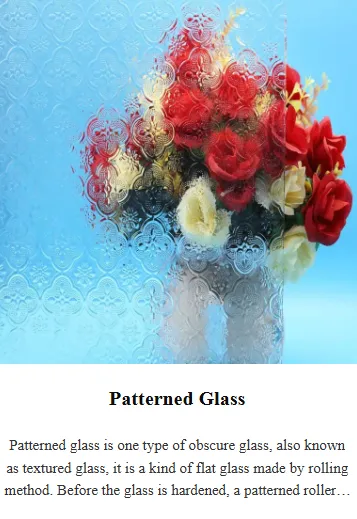
The production process of Pattern Glass is full of ingenuity
The core process of pattern glass texture is to press the surface of glass with patterned molds when it is in a molten state. After the glass cools and solidifies, the texture on the mold is permanently retained on the surface of the glass. The material of the mold is mostly high-temperature resistant metal or ceramic, and various patterns such as stripes, water ripples, diamonds, flowers, etc. can be carved on it. Different pressing forces and temperature controls can create varying levels of texture on the surface of the glass, resulting in different styles of Pattern Glass.
The performance characteristics of Pattern Glass make it significantly advantageous in practical applications
Firstly, textured glass shower doors have excellent light transmission and non perspective properties, allowing light to enter the interior through the glass but blurring the line of sight inside and outside, effectively protecting spatial privacy. Secondly, the surface texture can have a diffuse reflection effect on light, making the light entering the room softer and avoiding discomfort caused by direct sunlight. In addition, Pattern Glass has high mechanical strength, better impact resistance than ordinary flat glass, and its surface texture is not easily worn, which can maintain its beauty for a long time.
The application scenarios of Pattern Glass are rich and diverse
In the field of architectural decoration, textured glass patterns are commonly used for doors and windows in bathrooms, ensuring both natural lighting and privacy protection; The partition or background wall used for living rooms and dining rooms can create a unique spatial atmosphere through the interaction of texture and light. In furniture production, it is often used as a material for tabletops, cabinet doors, or screens to add artistic texture to furniture. In daily necessities such as lampshades, decorative frames, etc., the texture of Pattern Glass can reflect light to create a unique beauty, enhancing the ornamental value of the item.
With the innovation of design concepts, the development of Pattern Glass has also shown new trends
Designers integrate more cultural elements into texture design, making textured glass for windows not only a decorative material, but also a carrier of cultural expression, such as integrating traditional Paper Cuttings patterns, natural landscape patterns, etc. Meanwhile, the combination with other materials has become increasingly common, and when used in combination with metals, woods, etc., it can create richer visual effects through collision. In addition, there have been improvements in environmental performance by optimizing production processes, reducing energy consumption and pollutant emissions, making Pattern Glass more environmentally friendly.
In summary, Pattern Glass, with its unique manufacturing process, practical performance characteristics, wide range of application scenarios, and continuous innovative development, has become a high-quality material that combines functionality and artistry. It not only meets people's needs for privacy protection and light adjustment, but also injects more possibilities into spatial aesthetics, with irreplaceable value and broad development prospects.
Pattern Glass FAQs
What is pattern glass? What are its unique artistic features?
Pattern glass is a decorative glass product with exquisite embossed or etched patterns, commonly used in household items and architectural decoration. Its uniqueness lies in forming geometric, floral, or abstract textures on the surface of glass through molds or manual processes, which not only preserves the transparency of glass but also adds visual layering. This technique was particularly popular in the 19th century and is still used today to make retro style lamps, window decorations, and tableware.
What are the key technologies involved in the production process of pattern glass?
The production of pattern glass usually requires processes such as hot pressing, acid etching, or sandblasting. Hot pressing method is to pour molten glass into a mold with relief patterns and cool it to shape; Etching involves carving patterns on the surface of finished glass through chemical or physical means. Different processes can affect the precision of patterns and the durability of glass. For example, acid etching can achieve finer lines, but at a higher cost.
How to cleverly use pattern glass in interior design?
Pattern glass can add a low-key sense of luxury to a space, for example, when used as a screen partition, it can divide areas without blocking light; When used as cabinet doors or mirror frames, patterns can break the monotony. When choosing patterns, one should consider style coordination - complex Victorian patterns are suitable for classical decoration, while simple line patterns are more in line with modern minimalist style.
What should be paid attention to in the daily cleaning and maintenance of pattern glass?
Due to the tendency for dust to accumulate in the concave areas of the pattern, it is recommended to use a soft bristled brush to gently sweep the gaps during cleaning, and then wipe them with a neutral cleaning agent to avoid scratching the surface with hard tools. Long term placement should be kept away from high temperatures and strong light to prevent glass aging and fading. For styles with gold-plated borders, it is also necessary to regularly check for metal oxidation.
-
Enhance Your Home Decor with a Stylish Floor Length Mirror with Lights
NewsMar.31,2026
-
Elevate Your Bathroom with a Stylish Bathroom Round Mirror with Light
NewsMar.28,2026
-
Enhance Your Bathroom with the Perfect LED Vanity Mirror Bathroom Lighting
NewsMar.26,2026
-
Choosing the Perfect Illuminated Shaving Mirror For Your Daily Grooming Routine
NewsMar.24,2026
-
Choosing the Perfect Illuminated Dressing Table Mirror for Your Beauty Routine
NewsMar.21,2026
-
Enhance Your Space with a Stylish LED Mirror Black Frame A Comprehensive Guide
NewsMar.19,2026